
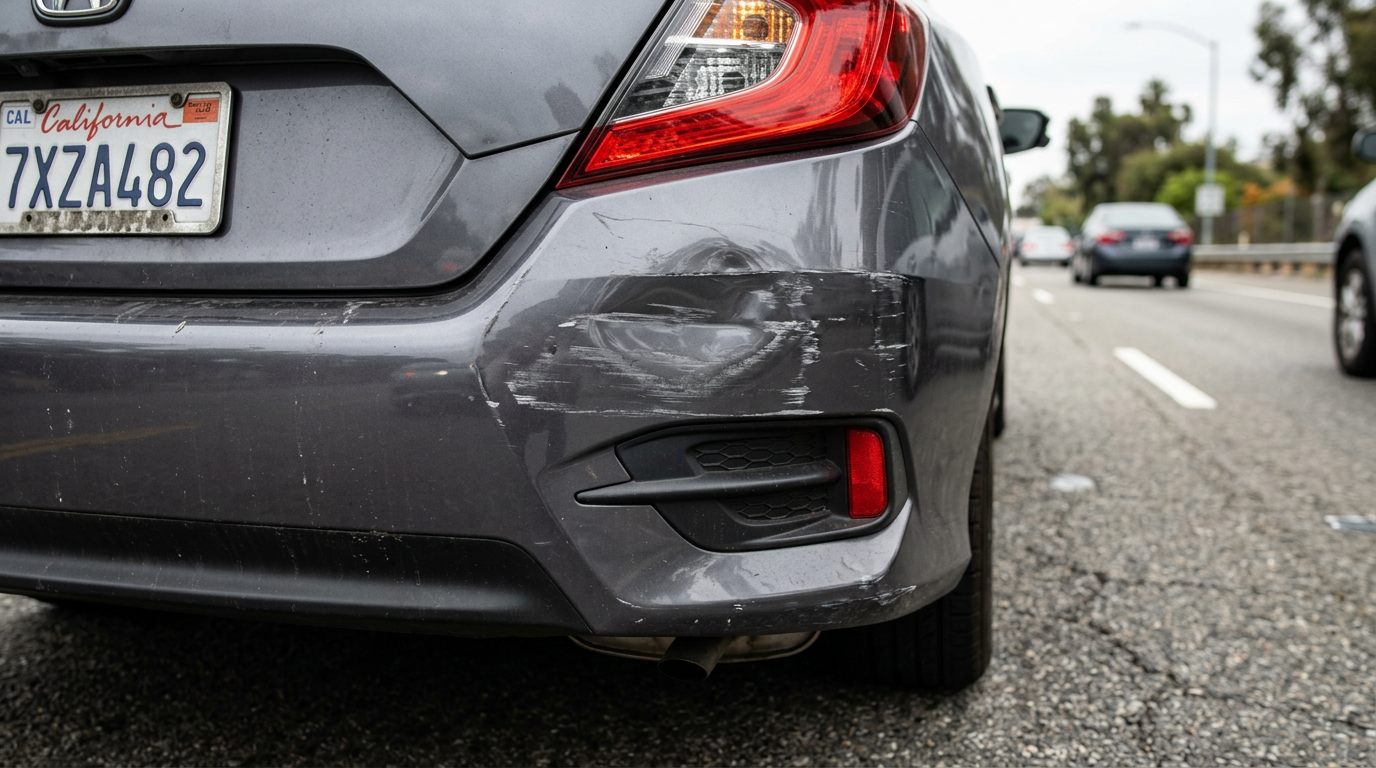
Rear-End Collision With Little Vehicle Damage: Can You Still Have a Serious Injury?
Published: March 12, 2026 · Last updated: March 12, 2026
TL;DR: Yes. Vehicle damage and occupant injury do not reliably correlate, especially in rear-end crashes. Low-speed impacts where the bumper barely shows a scratch are consistently the mechanism for serious whiplash and soft tissue injuries. Insurance companies know this and routinely use low property damage as a reason to deny or minimize personal injury claims. This guide explains the biomechanics of why, the research that supports it, and what you need to do to protect your claim.
The other driver barely tapped you. The bumper absorbed most of it. The adjuster looks at the photos of your car and says: “There’s almost no damage here. You couldn’t really be that hurt.”
This narrative is used constantly to underpay and deny legitimate injury claims. It sounds intuitive (the harder the hit, the worse the injuries), but the research doesn’t support it as a universal truth.
Why Low Vehicle Damage Doesn’t Mean Low Injury
Modern vehicle bumpers are engineered to protect the car, not the occupant. A bumper that absorbs a 5 mph impact and pops back into shape has done exactly what it was designed to do: minimize property damage costs.
The problem is that absorbing an impact into the car means less energy is transferred into the vehicle structure, but the occupant’s body is still subject to the forces involved. In a rear-end collision, the seated occupant’s torso is driven forward by the seat while the head (not immediately supported) lags behind. This differential creates the rapid extension-flexion motion that injures the cervical spine.
What the research shows:
Studies in biomechanical engineering and clinical spine research have consistently found that:
- Cervical spine injuries can occur at impact speeds as low as 5 to 10 mph
- The correlation between bumper damage and occupant injury is weak at low speeds
- Modern energy-absorbing bumper technology may actually increase occupant injury at low speeds by returning energy to the vehicle’s occupants rather than dissipating it into the structure
- Occupants in vehicles with stiffer bumpers (like trucks hitting smaller passenger cars) receive greater forces than the physical damage to either vehicle would suggest
A frequently cited study published in the journal Spine found that subjects in simulated rear impacts at speeds between 8 and 15 km/h (5 to 9 mph) reported neck symptoms consistent with whiplash, despite minimal or no vehicle damage.
What Injuries Can a Low-Speed Rear-End Crash Cause?
Whiplash and Cervical Spine Injury
The cervical spine (neck) is the most commonly injured area in rear-end collisions, regardless of speed. The rapid extension-flexion sequence overstretches the muscles, ligaments, and discs of the cervical spine. Injuries include:
- Cervical muscle and ligament sprains and strains
- Herniated or bulging cervical discs
- Cervicogenic headaches (headaches originating from the neck)
- Nerve root compression (causing radiating pain, numbness, or tingling in the arms)
- Facet joint injury
These injuries don’t require high speed. The position of the seat, the headrest setting, whether the occupant was looking forward or turned, and the stiffness of the seat back all affect outcome at any speed.
Thoracic and Lumbar Spine Injuries
The mid and lower back can also be affected, particularly when the seat transfers force upward and compresses the lumbar spine, or when the occupant braces for impact in a way that loads the lower back asymmetrically.
Soft Tissue Injuries to the Shoulder
Seat belt forces during rapid deceleration can injure the shoulder. Occupants who grip the steering wheel at impact may sustain shoulder, elbow, or wrist injuries from the jolt transmitted through the wheel.
Concussion
If the head strikes the headrest, the steering wheel, or the window during the collision, or if the jolt is severe enough even without direct contact, a concussion can occur. Concussion symptoms often emerge hours after the event (see delayed car accident symptoms).
Why Insurance Companies Use “Low Property Damage” as a Defense
The “low impact” or “low property damage” defense (sometimes abbreviated MIST, for “minor impact soft tissue,” in claims handling) is a documented insurer strategy. Its premise is that if the car wasn’t badly damaged, the occupant couldn’t have been badly hurt. In some jurisdictions, it is deployed so systematically that attorneys refer to it as boilerplate defense strategy.
Here’s why it’s scientifically questionable:
-
Bumper standards don’t protect the occupant. Federal bumper standards require that bumpers protect the vehicle from damage in low-speed collisions. They say nothing about occupant kinematics.
-
Energy dissipation is complex. Energy absorbed by the bumper is not the only energy involved. The interaction between the two vehicles, the stiffness of each structure, and the mass differential all affect how much energy is transmitted to the occupant.
-
Individual vulnerability differs. An occupant with a pre-existing cervical spine condition, degenerative disc disease, or prior surgery is significantly more vulnerable to injury from the same impact than a younger, healthy occupant. The law’s “eggshell plaintiff” doctrine addresses this: a defendant takes the victim as they find them.
-
Speed ≠ severity. Higher-speed crashes often produce more severe property damage but may produce less occupant injury in some configurations, because the collision forces are absorbed over a longer time period. Low-speed, high-stiffness collisions can be more injurious to the occupant than the property damage implies.
What Insurance Adjusters and Defense Attorneys Do in MIST Claims
If you file an injury claim after a rear-end collision with minor vehicle damage, expect the following:
- The adjuster will obtain repair estimates and use low dollar amounts to argue severity
- They may obtain biomechanical expert opinions stating that the forces involved were insufficient to cause injury
- They will look for inconsistencies between your reported symptoms and the timeline of your medical treatment
- They will look for treatment gaps, delayed care, or any admission by you that you felt “fine” initially
This is a predictable defense playbook. The counter to it is documentation: contemporaneous medical care from the day of or day after the accident, imaging (X-ray/MRI to document objective findings), consistent treatment, a symptom diary, and, if litigation is necessary, occupant biomechanics expert testimony to rebut the “low impact” argument.
What to Do After a Low-Speed Rear-End Collision
See a doctor the same day or the next morning. The most common mistake is waiting three to five days to see a doctor because the crash seemed minor. By then, the insurer will argue that your injuries couldn’t have been caused by the crash or that they weren’t serious enough to require immediate care. Go immediately and tell the doctor you were rear-ended.
Document the headrest and seat position. Where your headrest was positioned relative to your head matters enormously in a rear-end whiplash claim. Headrests that are too low provide less protection. Mention this to your treating physician and note it in your own records.
Note whether you saw the impact coming. Occupants who did not see the collision coming and had no chance to brace are generally more severely injured than those who braced. Bracing increases muscle pre-activation, which provides some protection. An unexpected impact allows the full unprotected whiplash motion to occur. Document this with your attorney.
Do not sign anything from the insurance company. Even a “property damage only” release may be worded broadly enough to extinguish your personal injury rights. Have an attorney review anything before you sign.
Request MRI imaging if you have neck or back symptoms. X-rays show bone fractures and alignment but do not show soft tissue injuries. An MRI is typically necessary to document disc herniations, ligament injuries, and nerve involvement. If your treating physician doesn’t order one, request it.
What If the Insurance Company Denies Your Claim Because of Low Damage?
A denial based on low property damage is not the end of the road. It is a negotiating position. The appropriate response is:
- Obtain your complete medical records from all treating providers and organize them chronologically
- Have your attorney engage a biomechanical expert if the case is significant enough to warrant it
- Consider a second medical opinion if the first provider’s records don’t fully capture your symptoms and functional limitations
- File a formal demand letter citing the relevant medical evidence and research literature on low-speed occupant injury
- Be prepared to litigate; many MIST claims settle in the litigation phase when the insurer’s biomechanical defense is challenged by competing expert testimony
Frequently Asked Questions
Can I have whiplash from a crash where my car barely shows any damage?
Yes. Whiplash is caused by the rapid extension-flexion of the cervical spine, not by visible vehicle damage. Modern bumpers are designed to absorb energy and minimize car damage, but the forces transmitted to the occupant can still be sufficient to cause injury, particularly at low speeds where the collision is brief and high in force-per-unit-time.
The adjuster told me my claim wasn’t worth much because of low damage. Is that true?
Low property damage is one factor, but it is not legally determinative of your injury or its value. Many courts have held that juries can find for the plaintiff in low-impact cases even when defense experts testify about force calculations. The quality of your medical documentation, treatment history, and the objective evidence of your injuries matters far more than the dollar amount of the car repair.
What is a MIST claim?
MIST stands for Minor Impact Soft Tissue. It is an insurance industry term for low-speed rear-end collision claims involving primarily soft tissue injuries. Insurers have specific handling protocols for MIST claims, often including low initial offers and systematic use of property damage photographs to minimize value.
Is a rear-end collision always the following driver’s fault?
Generally yes, there is a legal presumption that the following driver in a rear-end collision was following too closely or failed to stop in time. This presumption can be rebutted if the lead driver made a sudden, unexpected, or unreasonable stop. In practice, rear-end liability is disputed in relatively few cases.
The Bottom Line
A small dent doesn’t mean a small injury. The biomechanics of rear-end collisions make the neck and spine vulnerable at speeds that cause minimal property damage. If you were rear-ended and felt pain afterward, even if the car looks fine, document everything, get medical care, and don’t accept a low-value offer based on vehicle damage photos.
For legal options specific to rear-end collisions and how a participating attorney can help push back against low-damage arguments, see our rear-end collision case review page.
If the insurance company is using low damage to push back on your claim, get a free case review to understand what your case is actually worth.
Related guides: